
Staying physically active after 60 is one of the most powerful things you can do for your health, independence, and quality of life. Regular exercise for seniors reduces the risk of heart disease, stroke, type 2 diabetes, and certain cancers. It strengthens bones, preserves muscle mass, improves balance, and significantly lowers the risk of dangerous falls, which are the leading cause of injury among older adults worldwide.
Yet many seniors avoid exercise out of fear of injury or because they don’t know where to start. The truth is that the risks of inactivity far outweigh the risks of appropriate exercise. This guide covers the Best Exercises for People Over 60, carefully designed to improve strength, balance, flexibility, and overall health. It also includes safe progressions, a complete weekly schedule, and essential safety guidelines. Every recommendation is supported by current medical research and follows guidelines from the World Health Organization and the American College of Sports Medicine.
1. Why Exercise Is Critical After 60
2. The 4 Types of Exercise Every Senior Needs
3. Best Cardio Exercises for Seniors
4. Strength Training for Seniors
5. Balance Exercises for Fall Prevention
6. Flexibility and Stretching Exercises
7. Sample Weekly Exercise Schedule
8. Essential Safety Tips
9. Frequently Asked Questions
10. Conclusion
Why Exercise Is Critical After 60
After age 30, adults lose approximately 3 to 5 percent of their muscle mass per decade, a process called sarcopenia that accelerates significantly after 60. Without regular strength-building activity, this muscle loss leads to weakness, reduced mobility, and increased dependence on others for daily tasks. Exercise is the most effective intervention to slow and even reverse this decline.
The benefits of regular physical activity for seniors extend far beyond muscles and bones. A landmark study published in the British Journal of Sports Medicine found that seniors who exercise regularly have a 35 percent lower risk of cardiovascular disease, a 40 percent lower risk of falls, and a 30 percent reduction in symptoms of depression and anxiety compared to sedentary peers. Exercise also improves cognitive function, with multiple studies showing that regular physical activity reduces the risk of dementia by 20 to 30 percent. The World Health Organization recommends that adults over 65 engage in at least 150 minutes of moderate-intensity aerobic activity per week, combined with muscle-strengthening activities on two or more days, and balance training at least three days per week. This guide shows you exactly how to meet and exceed these recommendations safely.
The 4 Types of Exercise Every Senior Needs
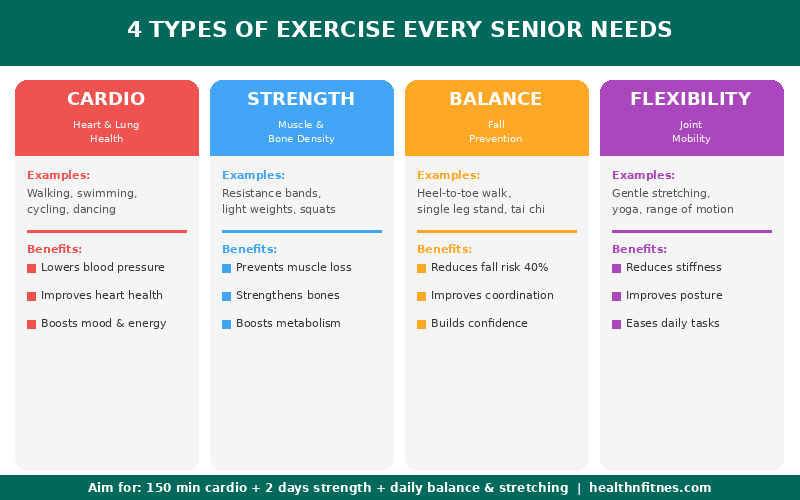
A complete senior fitness program incorporates four distinct types of exercise, each serving a unique and essential purpose. Focusing on only one type, such as walking alone, leaves critical gaps that increase injury risk and limit overall health benefits. The four pillars are cardiovascular exercise, strength training, balance work, and flexibility training.
Best Cardio Exercises for Seniors
Walking: The Foundation
Walking is the single best starting exercise for most seniors. It requires no equipment, no gym membership, and can be done at any pace that feels comfortable. Research from the American Heart Association shows that just 30 minutes of brisk walking five days a week reduces heart disease risk by 19 percent and all-cause mortality by 20 percent. Start with 10 to 15 minutes at a comfortable pace and gradually increase duration by 5 minutes each week until you reach 30 to 45 minutes per session.
Swimming and Water Aerobics
Water-based exercises are ideal for seniors with joint pain, arthritis, or limited mobility. The buoyancy of water supports your body weight, reducing stress on joints by up to 90 percent while still providing excellent cardiovascular and muscular benefits. Swimming laps, water walking, and water aerobics classes burn 300 to 500 calories per hour while building endurance and strength simultaneously. Many community pools offer dedicated senior swim times and instructor-led aqua fitness classes.
Cycling and Dancing
Stationary cycling provides an excellent low-impact cardio workout with minimal fall risk, making it perfect for seniors with balance concerns. Recumbent bikes offer additional back support and are particularly comfortable for those with lower back issues. Social dancing, including ballroom, line dancing, or even dance fitness classes, combines cardiovascular exercise with coordination training, social interaction, and cognitive engagement, making it one of the most complete forms of exercise for brain and body health.
Strength Training for Seniors
Chair-Based Strength Exercises
Chair exercises are an excellent entry point for seniors who are new to strength training or have limited mobility. Seated leg extensions, chair squats where you stand up from and sit down into a chair, seated arm raises with light weights, and seated marching all build functional strength while minimizing fall risk. Perform 2 to 3 sets of 10 to 12 repetitions for each exercise, using a sturdy chair without wheels on a non-slip surface.
Resistance Band Training
Resistance bands are one of the safest and most versatile strength training tools for seniors. They are inexpensive, lightweight, portable, and available in multiple resistance levels. Start with light resistance bands and perform exercises like seated rows, chest presses, bicep curls, and leg presses. Resistance bands provide constant tension throughout the movement, effectively strengthening muscles and connective tissues without the joint stress that heavy dumbbells can cause.
Bodyweight Exercises
Wall push-ups, standing calf raises, bodyweight squats to a chair, and step-ups on a low platform are all effective bodyweight exercises for seniors. These movements use your own body as resistance and can be progressively made more challenging as strength improves. Start with wall push-ups before progressing to counter push-ups and eventually modified floor push-ups. Always have a stable surface nearby for support during standing exercises.
Balance Exercises for Fall Prevention
Falls are the leading cause of fatal and non-fatal injuries among adults over 65, with one in four seniors experiencing a fall each year. The good news is that targeted balance training can reduce fall risk by up to 40 percent according to a comprehensive meta-analysis published in the BMJ.
Read More: 5 Minute Morning Stretch Routine for Busy People (No Equipment Needed)
Start with simple exercises like standing on one foot while holding a chair for support, progressing to holding for 30 seconds on each side without support. Heel-to-toe walking, where you place one foot directly in front of the other as if walking on a tightrope, improves dynamic balance and coordination. Tai chi is particularly effective for seniors, as multiple clinical trials have demonstrated its ability to reduce fall rates by 43 percent while simultaneously improving flexibility, strength, and mental wellbeing. Practice balance exercises daily for the best results. Even three to five minutes per day produces meaningful improvements within two to four weeks. Always perform balance exercises near a wall or sturdy furniture for safety, especially when beginning a new routine.
Flexibility and Stretching Exercises
Flexibility naturally decreases with age as connective tissues lose elasticity and joints stiffen. Regular stretching counteracts this decline, improving range of motion, reducing stiffness, easing chronic pain, and making everyday activities like reaching overhead, bending to tie shoes, and turning to look behind you significantly easier.
Perform gentle stretches for all major muscle groups at least five days per week, ideally after your muscles are warm from cardio or strength training. Hold each stretch for 15 to 30 seconds without bouncing, breathing deeply and relaxing into the stretch. Focus on neck rotations, shoulder rolls, chest openers, hamstring stretches, calf stretches, and hip flexor stretches. Gentle yoga classes designed for seniors are an excellent way to combine flexibility work with balance training and mindfulness.
Sample Weekly Exercise Schedule
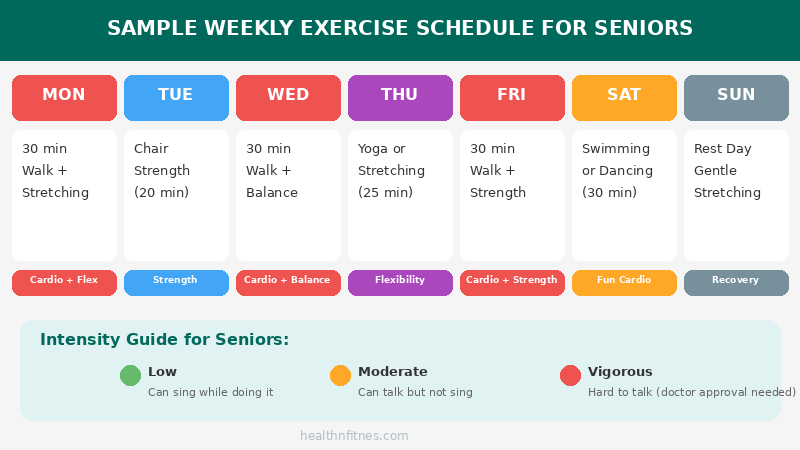
This balanced weekly plan meets WHO recommendations while allowing adequate recovery time. Adjust the specific activities to match your preferences and fitness level, but maintain the overall structure of alternating exercise types throughout the week.
| Day | Activity | Type | Duration |
|---|---|---|---|
| Monday | Brisk walking + stretching | Cardio + Flexibility | 30 + 10 min |
| Tuesday | Chair strength exercises | Strength | 20-25 min |
| Wednesday | Walking + balance drills | Cardio + Balance | 30 + 10 min |
| Thursday | Gentle yoga or stretching | Flexibility + Balance | 25-30 min |
| Friday | Walking + resistance bands | Cardio + Strength | 30 + 15 min |
| Saturday | Swimming, cycling, or dancing | Fun Cardio | 30-45 min |
| Sunday | Rest day – gentle stretching only | Recovery | 10-15 min |
| TOTAL | Meets WHO guidelines | All 4 types covered | ~175-220 min/week |
Essential Safety Tips
Safety is the top priority for any Senior Exercise Program. Taking precautions does not mean limiting yourself; it means exercising intelligently so you can stay active for years to come. The following guidelines are recommended by geriatric exercise specialists and should be followed consistently.
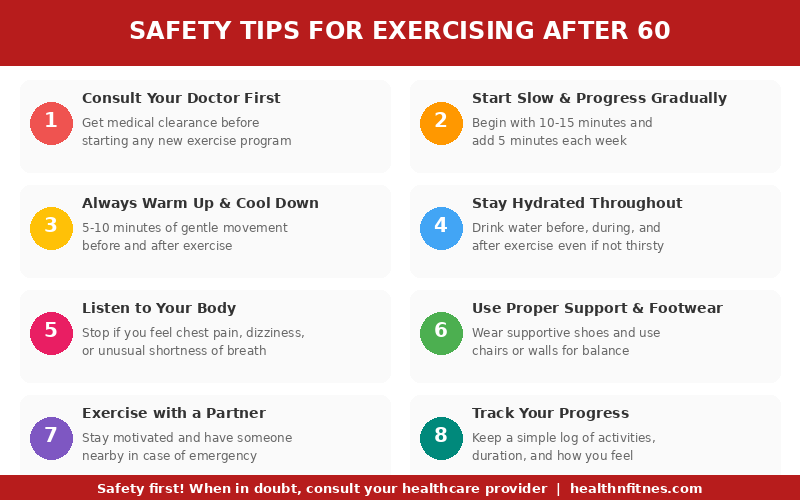
Always consult your doctor before starting a new exercise program, especially if you have heart disease, diabetes, arthritis, osteoporosis, or any chronic condition. Start slowly with 10 to 15 minutes per session and add 5 minutes each week as your fitness improves. Never skip your warm-up or cool-down; 5 to 10 minutes of gentle movement before and after exercise prepares your body and prevents injury. Stay hydrated by drinking water before, during, and after exercise, even if you do not feel thirsty, as the thirst mechanism becomes less reliable with age. Wear supportive, well-fitting shoes with non-slip soles. Exercise on flat, stable surfaces and always have a chair, wall, or railing within reach during standing exercises. Stop immediately if you experience chest pain, dizziness, severe shortness of breath, or joint pain that persists after exercise.
Frequently Asked Questions
Q1: Is it too late to start exercising at 60 or 70?
Absolutely not. Research consistently shows that people who begin exercising even in their 70s and 80s experience significant health improvements. A study published in the British Medical Journal found that previously sedentary adults who started exercising after 60 reduced their mortality risk by 30 to 35 percent compared to those who remained inactive. Your body retains the ability to build muscle, improve cardiovascular fitness, and enhance balance at any age. Start where you are and progress gradually.
Q2: How many days per week should seniors exercise?
The WHO recommends at least 150 minutes of moderate-intensity activity spread across the week, ideally five or more days. Additionally, strength training should be performed on two or more days, and balance exercises on three or more days. The sample schedule in this guide meets all of these recommendations with one full rest day per week. However, even two to three days of activity provides meaningful health benefits compared to complete inactivity.
Q3: What if I have arthritis or joint pain?
Exercise is actually recommended as a primary treatment for arthritis by rheumatologists worldwide. Low-impact activities like water aerobics, gentle cycling, chair exercises, and yoga specifically designed for arthritis patients reduce pain and stiffness while improving joint function and mobility. Avoid high-impact activities like running or jumping, and focus on smooth, controlled movements. Warm up thoroughly before exercise and apply ice to affected joints afterward if needed.
Q4: Do I need equipment or a gym membership?
No. Every exercise in this guide can be performed at home with no equipment or minimal, inexpensive items. Walking requires only a good pair of shoes. Chair exercises and bodyweight movements use furniture you already have. Resistance bands cost 10 to 20 dollars and last for years. A yoga mat provides comfort for floor stretches. While gyms and pools offer additional options and social interaction, they are entirely optional for an effective senior fitness program.
Q5: How quickly will I see results from exercising?
Many seniors report improved mood, better sleep, and increased energy within the first one to two weeks of regular exercise. Physical improvements like better balance, increased strength, and improved endurance typically become noticeable within four to six weeks. Measurable changes in blood pressure, blood sugar levels, and cholesterol markers often appear within eight to twelve weeks. The key is consistency: regular moderate exercise produces far better results than occasional intense sessions.
Conclusion
Exercise after 60 is not about running marathons or lifting heavy weights. It is about maintaining the strength, balance, flexibility, and cardiovascular health that allow you to live independently, enjoy your favorite activities, and spend quality time with family and friends for as long as possible. The exercises in this guide are safe, effective, and accessible to seniors of all fitness levels.
Start today with whatever you can manage. A 10-minute walk around your neighborhood, five minutes of gentle stretching, or a few chair squats during television commercials. Every minute of movement counts, and small consistent efforts compound into transformative results over weeks and months. Your future self will thank you for the investment you make in your health today. For more senior wellness resources, including our nutrition guide for healthy aging, yoga for beginners, and sleep optimization tips, visit healthnfitnes.com. Share this article with a parent, grandparent, or friend who could benefit from safe, guided exercise recommendations.