Yoga is one of the oldest and most transformative practices known to humanity, with roots stretching back over 5,000 years in ancient India. In 2026, yoga has become more accessible and popular than ever, with millions of people worldwide discovering its incredible benefits for physical health, mental clarity, and emotional balance. Whether you are a complete beginner or someone looking to restart your practice, this comprehensive guide will walk you through everything you need to know to Yoga for Beginners journey with confidence.
Unlike many other forms of exercise, yoga does not require expensive equipment, a gym membership, or exceptional physical fitness to start. All you need is a quiet space, a yoga mat, and the willingness to show up for yourself. Yoga meets you exactly where you are, whether you are 18 or 80, flexible or stiff, athletic or sedentary. It is a practice of self-discovery that combines physical postures, breathing techniques, and mindfulness to create a holistic approach to health and wellbeing. This guide is specifically designed for beginners and covers essential poses, breathing exercises, a weekly schedule, and practical tips to help you build a sustainable and enjoyable yoga practice.
What is Yoga? Understanding the Basics
The word yoga comes from the Sanskrit word yuj, which means to unite or to join. At its core, yoga is the union of body, mind, and breath. While many people associate yoga primarily with physical postures, it is actually a comprehensive system that encompasses ethical principles, breathing techniques, meditation, and spiritual philosophy. However,Yoga for Beginners, the physical practice of yoga postures, known as asanas, is the most accessible entry point.
Modern yoga comes in many styles, each offering different benefits and experiences. Hatha yoga is the most Yoga for Beginners-friendly style, focusing on basic poses held for longer durations with emphasis on proper alignment. Vinyasa yoga links poses together in a flowing sequence synchronized with breath, providing a more dynamic workout. Yin yoga involves holding passive poses for extended periods to stretch deep connective tissues. Restorative yoga uses props to support the body in gentle poses for deep relaxation. For beginners, starting with Hatha or a gentle Vinyasa class is highly recommended. The beauty of yoga lies in its adaptability. Every pose can be modified to suit your body and ability level. There is no such thing as being too inflexible for yoga; in fact, inflexibility is one of the best reasons to start. Yoga progressively increases your range of motion, strengthens your muscles, improves your balance, and calms your nervous system, all while being gentle on your joints.
Health Benefits of Yoga (Science-Backed)
Scientific research has consistently demonstrated that regular yoga practice offers a wide range of health benefits that extend far beyond flexibility. Understanding these benefits can provide powerful motivation for beginners to establish and maintain their practice.
Physical and Mental Benefits Comparison
| Benefit Category | Specific Benefit | Timeline to Notice | Research Support |
|---|---|---|---|
| Flexibility | Increased range of motion | 2-4 weeks | Multiple studies confirm |
| Strength | Improved muscle tone | 4-6 weeks | Equivalent to bodyweight training |
| Stress Relief | Reduced cortisol levels | Immediate – 1 week | Proven in clinical trials |
| Sleep Quality | Deeper, more restful sleep | 1-2 weeks | Better than sleep hygiene alone |
| Back Pain | Reduced chronic pain | 4-8 weeks | Recommended by medical guidelines |
| Heart Health | Lower blood pressure | 8-12 weeks | Comparable to aerobic exercise |
| Mental Health | Reduced anxiety and depression | 2-4 weeks | Strong clinical evidence |
| Balance | Fall prevention improvement | 4-8 weeks | Especially beneficial for seniors |
| Immunity | Enhanced immune response | 8-12 weeks | Linked to reduced inflammation |
Yoga also improves respiratory function through its emphasis on deep, controlled breathing. Studies have shown that regular pranayama practice increases lung capacity, improves oxygen saturation, and helps manage conditions like asthma and chronic obstructive pulmonary disease. Additionally, yoga has been shown to reduce markers of inflammation in the body, which is linked to chronic diseases including heart disease, diabetes, and certain cancers.
Essential Yoga Poses for Beginners: Step-by-Step Guide
Learning the foundational yoga poses correctly is crucial for building a safe and effective practice. These six essential poses form the building blocks of most yoga sequences and will help you develop strength, flexibility, and body awareness. Always listen to your body and never push into pain.
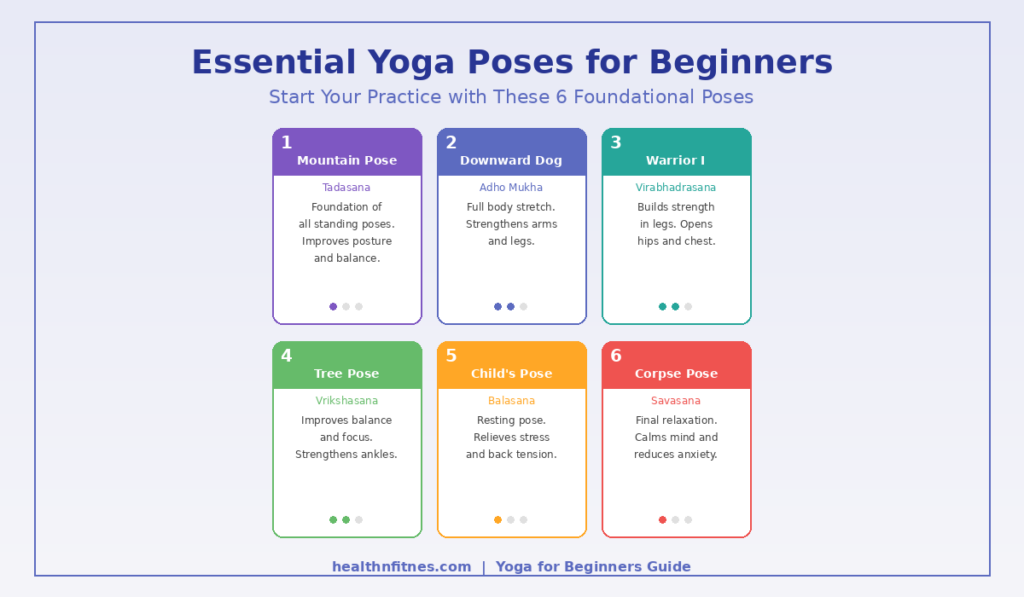
1. Mountain Pose (Tadasana)
Mountain Pose is the foundation of all standing poses and teaches you proper alignment and body awareness. Stand with your feet together or hip-width apart, distribute your weight evenly across both feet, engage your thigh muscles gently, lengthen your spine upward, roll your shoulders back and down, and let your arms hang naturally with palms facing forward. Hold for 5 to 10 breaths. This pose may look simple, but it teaches the principles of grounding and alignment that carry into every other pose.
2. Downward-Facing Dog (Adho Mukha Svanasana)
Downward-Facing Dog is one of the most recognized yoga poses and provides a full-body stretch. Start on your hands and knees with hands shoulder-width apart and knees hip-width apart. Tuck your toes, lift your knees off the floor, and push your hips up and back to form an inverted V shape. Press your hands firmly into the mat, spread your fingers wide, and try to push your heels toward the floor without forcing them. Keep a slight bend in your knees if your hamstrings are tight. Hold for 5 to 8 breaths. This pose strengthens the arms, shoulders, and legs while stretching the hamstrings, calves, and spine.
3. Warrior I (Virabhadrasana I)
Warrior I builds strength and stability in the legs while opening the hips and chest. From Mountain Pose, step your left foot back about 3 to 4 feet. Bend your right knee to 90 degrees, keeping it directly over your ankle. Turn your left foot out slightly at a 45-degree angle and press it firmly into the mat. Raise both arms overhead with palms facing each other. Square your hips forward and gently arch your upper back. Hold for 5 breaths, then switch sides. This pose builds leg strength, improves hip flexibility, and develops mental focus.
4. Tree Pose (Vrikshasana)
Tree Pose is an excellent balance pose that strengthens the ankles, calves, and core while improving concentration. Stand in Mountain Pose, shift your weight onto your left foot, and slowly place the sole of your right foot on your inner left thigh, calf, or ankle, but never on the knee joint. Press your foot and standing leg into each other for stability. Bring your hands together at your heart center or raise them overhead. Fix your gaze on a steady point in front of you. Hold for 5 to 8 breaths, then switch sides. If you find balance challenging, practice near a wall for support.
5. Child’s Pose (Balasana)
Child’s Pose is a gentle resting pose that you can return to at any time during your practice when you need a break. Kneel on the floor with your big toes touching and knees either together or spread wide. Sit back on your heels, then fold forward and extend your arms out in front of you or alongside your body with palms facing up. Rest your forehead on the mat. Breathe deeply into your back body. Hold for as long as you need. This pose gently stretches the hips, thighs, and ankles while relieving stress and calming the mind.
6. Corpse Pose (Savasana)
Savasana is traditionally the final pose in every yoga session and is considered one of the most important poses despite appearing the simplest. Lie flat on your back with your legs extended and feet falling open naturally. Place your arms alongside your body with palms facing up. Close your eyes and consciously relax every part of your body from your toes to the crown of your head. Focus on your natural breath without trying to control it. Stay in this pose for 5 to 10 minutes. Savasana allows your body to integrate the benefits of your practice and deeply relaxes the nervous system.
Read More:
Yoga Breathing Techniques: Pranayama Guide for Beginners
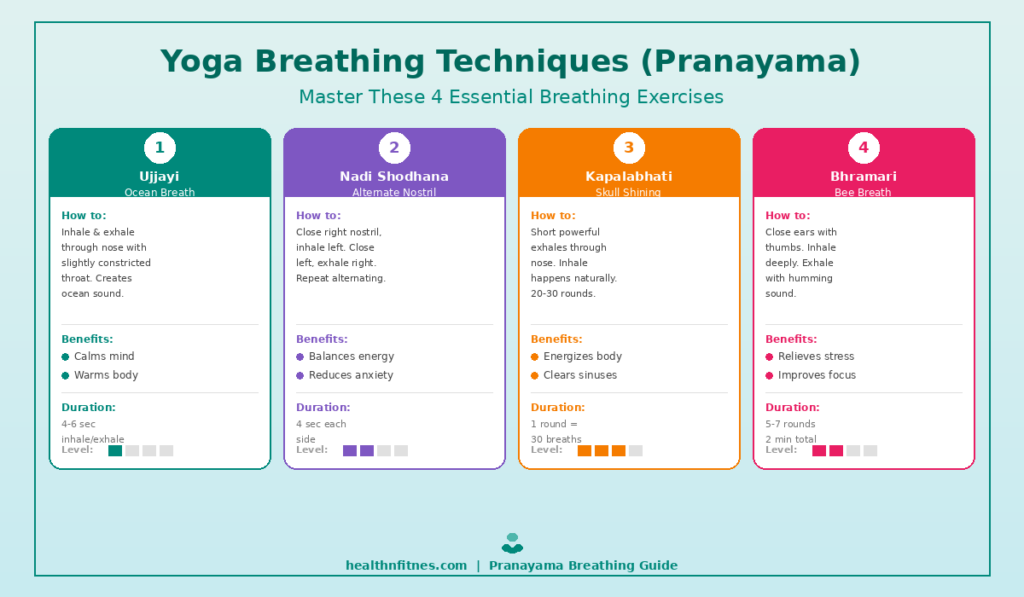
Pranayama, the practice of controlled breathing, is a fundamental aspect of yoga that is often underestimated by beginners. The word pranayama comes from prana meaning life force or breath and ayama meaning to extend or control. Proper breathing techniques can dramatically enhance your yoga practice, reduce stress, improve lung capacity, and create a deep sense of calm and focus. Here are four essential pranayama techniques every beginner should learn.
Ujjayi Pranayama (Ocean Breath)
Ujjayi breath is the most commonly used breathing technique during yoga practice. It involves breathing in and out through the nose while slightly constricting the back of the throat to create a soft, ocean-like sound. To practice, inhale slowly through your nose for 4 counts, feeling your chest and belly expand. Exhale through your nose for 6 counts, creating a gentle whispering sound. This technique warms the body, calms the mind, and helps maintain focus during challenging poses. Practice for 5 minutes daily.
Nadi Shodhana (Alternate Nostril Breathing)
Nadi Shodhana is a powerful balancing breath that harmonizes the left and right hemispheres of the brain. Sit comfortably with your spine straight. Use your right thumb to close your right nostril. Inhale slowly through the left nostril for 4 counts. Close the left nostril with your ring finger, open the right nostril, and exhale for 4 counts. Inhale through the right nostril for 4 counts, then switch and exhale through the left. This completes one cycle. Practice 5 to 10 cycles. This technique is excellent for reducing anxiety and creating mental clarity.
Kapalabhati (Skull-Shining Breath)
Kapalabhati is an energizing breathing technique that involves short, powerful exhales and passive inhales. Sit tall, take a deep breath in, then forcefully exhale through your nose by contracting your abdominal muscles. The inhale happens naturally as your belly relaxes. Start with 20 rounds at a moderate pace, then rest and breathe normally for 30 seconds. Repeat for 3 sets. This technique energizes the body, clears the nasal passages, improves digestion, and strengthens the abdominal muscles. Avoid this technique if you are pregnant or have high blood pressure.
Bhramari (Bee Breath)
Bhramari pranayama creates a soothing humming vibration that instantly calms the nervous system. Sit comfortably, close your eyes, and gently place your index fingers on the cartilage of your ears. Take a deep inhale through your nose. As you exhale, gently press on the ear cartilage and make a low humming sound like a bee. Feel the vibrations throughout your head and face. Practice 5 to 7 rounds. This technique is particularly effective for reducing anger, anxiety, insomnia, and blood pressure. It can be practiced anytime you feel overwhelmed or stressed.
7-Day Beginner Yoga Schedule
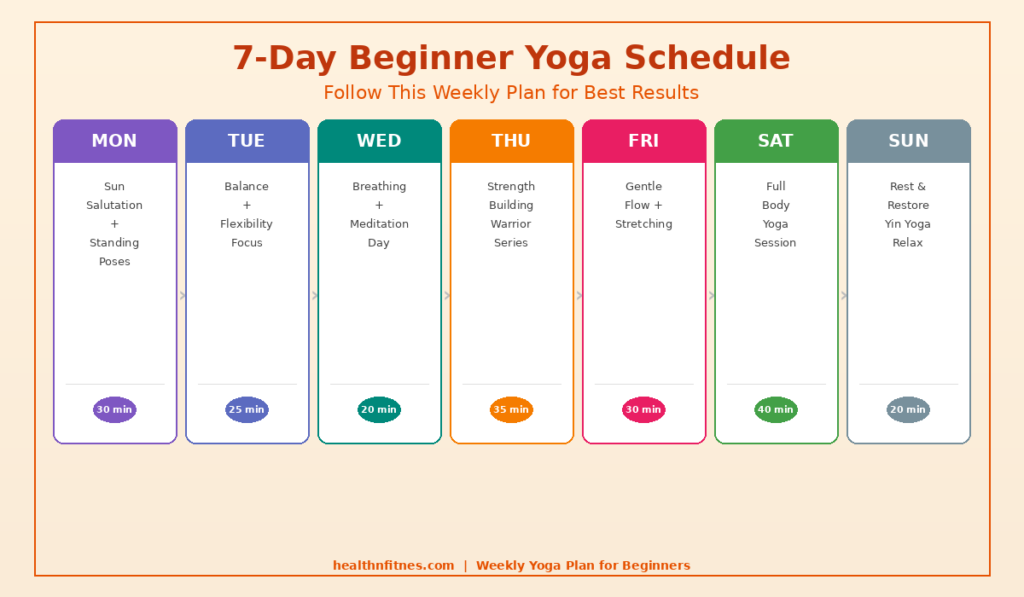
Consistency is the key to progress in yoga. This beginner-friendly weekly schedule is designed to introduce you to different aspects of yoga while ensuring adequate rest and recovery. Each session is short enough to fit into a busy schedule but comprehensive enough to deliver real results. Feel free to adjust the timing based on your comfort level.
Detailed Weekly Plan
| Day | Focus Area | Key Poses/Activities | Duration |
|---|---|---|---|
| Monday | Sun Salutation + Standing | Surya Namaskar A (3 rounds), Mountain, Warrior I, Tree | 30 min |
| Tuesday | Balance + Flexibility | Tree Pose, Eagle, Half Moon, Seated Forward Fold | 25 min |
| Wednesday | Breathing + Meditation | Ujjayi, Nadi Shodhana, 10 min guided meditation | 20 min |
| Thursday | Strength Building | Warrior I, II, III, Plank, Chair Pose, Bridge | 35 min |
| Friday | Gentle Flow + Stretch | Cat-Cow, Downward Dog flow, Pigeon, Supine Twist | 30 min |
| Saturday | Full Body Session | Complete sequence combining all weeks poses | 40 min |
| Sunday | Rest + Restorative | Childs Pose, Supported Bridge, Legs Up Wall, Savasana | 20 min |
Common Mistakes Beginners Should Avoid
Starting yoga is exciting, but beginners often make mistakes that can slow their progress or even lead to injury. Being aware of these common pitfalls will help you build a safer and more effective practice from the very beginning.
- Comparing yourself to others is the most common mistake in yoga. Every body is different, and yoga is not a competition. Focus on your own practice and celebrate your personal progress, no matter how small.
- Holding your breath during poses is something many beginners do unconsciously, especially during challenging poses. Always maintain steady, controlled breathing throughout your practice. If you cannot breathe smoothly in a pose, you are pushing too hard.
- Skipping the warm-up and jumping directly into advanced poses can lead to muscle strains and injuries. Always begin with gentle warm-up movements and basic poses before progressing to more challenging asanas.
- Ignoring pain signals from your body is dangerous. There is a difference between the mild discomfort of a good stretch and actual pain. If you feel sharp, shooting, or burning pain, come out of the pose immediately.
- Neglecting Savasana at the end of practice is like leaving a meal before dessert. This final relaxation pose allows your body to absorb the benefits of your practice and is essential for your nervous system recovery.
- Practicing on a full stomach can cause discomfort, nausea, and cramps. Wait at least 2 hours after a heavy meal before practicing yoga. A light snack 30 minutes before is fine.
- Trying advanced poses too quickly can lead to injury and frustration. Master the basics first. Advanced poses will come naturally with consistent practice over time.
READ MORE: 7-Day Meal Plan for Weight Loss (1500 Calories) | Free Printable Guide
Yoga Equipment and Setup Guide
One of the wonderful things about yoga is that it requires minimal equipment. However, having the right basics can significantly enhance your comfort and practice quality. Here is what you need to get started.
Essential vs Optional Equipment
| Equipment | Essential or Optional | Why You Need It |
|---|---|---|
| Yoga Mat | Essential | Provides grip, cushioning, and personal space |
| Comfortable Clothing | Essential | Allows free movement without restriction |
| Yoga Blocks (2) | Highly Recommended | Bring the floor closer, support alignment |
| Yoga Strap | Recommended | Extends reach for tight hamstrings |
| Bolster/Pillow | Optional | Support in restorative and seated poses |
| Blanket | Optional | Warmth in Savasana, knee cushioning |
| Water Bottle | Essential | Stay hydrated before and after practice |
Tips for Building a Consistent Yoga Practice
The most important factor in yoga is not how flexible you are or how advanced your poses are. It is consistency. Here are practical tips that will help you turn yoga from an occasional activity into a sustainable daily habit.
- Start small with just 10-15 minutes a day. A short daily practice is far more beneficial than a long session once a week. You can gradually increase the duration as your body adapts.
- Practice at the same time every day to build a routine. Morning practice energizes you for the day ahead, while evening practice helps release tension and prepare for restful sleep.
- Create a dedicated yoga space in your home, even if it is just a corner. Having a designated area with your mat rolled out makes it easier to step onto the mat without overthinking.
- Set realistic expectations and be patient with yourself. Progress in yoga is gradual and nonlinear. Some days will feel easier than others, and that is completely normal.
- Use guided videos or apps when practicing at home. Platforms like YouTube offer thousands of free beginner yoga classes that provide clear instructions and proper pacing.
- Listen to your body every single day. Your body feels different each day based on sleep, stress, nutrition, and many other factors. Honor what your body needs rather than forcing a specific outcome.
- Keep a yoga journal to track your practice, note how you feel before and after sessions, and celebrate milestones. This builds awareness and motivation over time.
- Find a yoga community, whether online or in person. Having like-minded people to share your journey with provides accountability, support, and inspiration.
Frequently Asked Questions (FAQ)
Q1: Can I do yoga if I am not flexible at all?
A: Absolutely! Flexibility is not a prerequisite for yoga; it is a result of regular practice. Yoga meets you exactly where you are. Every pose can be modified using blocks, straps, or simpler variations. Many of the most dedicated yoga practitioners started out extremely stiff. Within just 2 to 4 weeks of consistent practice, you will notice significant improvements in your flexibility. The key is to be patient and never force your body into positions that cause pain.
Q2: How often should beginners practice yoga?
A: For beginners, practicing yoga 3 to 5 times per week is ideal for building consistency and seeing noticeable results. Even 15 to 20 minutes daily is more beneficial than one long session per week. As your body adapts and you begin to enjoy the practice more, you can gradually increase both the frequency and duration. Always include at least one rest day per week to allow your muscles to recover and your body to integrate the benefits of your practice.
Q3: What is the best time of day to practice yoga?
A: The best time to practice yoga is whenever you can do it consistently. That said, traditional yoga philosophy recommends early morning practice during the Brahma Muhurta period, approximately 90 minutes before sunrise, when the mind is naturally calm and the atmosphere is peaceful. Morning yoga energizes the body and sets a positive tone for the entire day. Evening practice is excellent for releasing accumulated stress and tension. The most important thing is to choose a time that fits your schedule and stick with it.
Q4: Do I need to be vegetarian to practice yoga?
A: No, you do not need to be vegetarian to practice yoga. While some yoga traditions recommend a plant-based diet as part of the ethical principle of ahimsa or non-violence, modern yoga is inclusive and does not require any specific dietary choices. Many successful yoga practitioners follow various diets based on their personal preferences, health needs, and cultural backgrounds. Focus on eating a balanced, nutritious diet that supports your energy levels and overall health. As your yoga practice deepens, you may naturally find yourself gravitating toward lighter and healthier food choices.
Q5: What should I eat before and after yoga practice?
A: It is best to practice yoga on an empty or light stomach. Avoid eating a heavy meal 2 to 3 hours before practice. If you need a small snack, have something light like a banana, a handful of nuts, or a few dates about 30 minutes before. After practice, wait at least 20 to 30 minutes before eating. Post-yoga, choose a balanced meal or snack that includes protein for muscle recovery, complex carbohydrates for energy replenishment, and healthy fats. Staying well hydrated before and after practice is also essential.
Conclusion
Yoga is one of the most rewarding gifts you can give yourself. It requires no special talent, no expensive equipment, and no perfect body. All it asks is that you show up, breathe, and be present. Whether your goal is to improve flexibility, reduce stress, build strength, or simply find a few moments of peace in your busy day, yoga can deliver all of this and more.
Remember that every expert was once a beginner. The poses that seem impossible today will become second nature with regular practice. Be patient with yourself, celebrate small victories, and enjoy the journey. Your body, mind, and spirit will thank you for every moment you spend on the mat. Start today, start now, and let yoga transform your life one breath at a time.
| Ready to Start Your Yoga Journey? Share this guide with someone who wants to start yoga! Visit healthnfitnes.com for more wellness articles. |