
Reset Your Circadian Rhythm | Sleep Hygiene Checklist | Bedtime Routine | Recovery Timeline
A disrupted sleep schedule affects far more than just your energy levels. Poor sleep is linked to weight gain, weakened immunity, impaired cognitive function, increased stress, and a significantly higher risk of chronic diseases including heart disease, diabetes, and depression. Yet despite its critical importance, sleep is one of the most neglected aspects of modern health.
If you find yourself lying awake at midnight, hitting the snooze button repeatedly, or feeling exhausted despite spending enough hours in bed, your circadian rhythm has likely fallen out of alignment. The good news is that sleep science has advanced enormously in recent years, and researchers now understand exactly how to reset your internal clock and restore healthy sleep patterns. This guide walks you through every evidence-based strategy you need to fix your sleep schedule permanently, not just for a few nights.
In this guide, you will learn everything step-by-step.
Understanding Your Circadian Rhythm
Your circadian rhythm is an internal 24-hour biological clock located in the suprachiasmatic nucleus of your brain’s hypothalamus. This master clock regulates your sleep-wake cycle by controlling the release of hormones, particularly melatonin and cortisol, that signal when it is time to sleep and when it is time to be alert. Light is the most powerful external cue that synchronizes your circadian rhythm. When your eyes detect bright light, especially natural sunlight, your brain suppresses melatonin production and increases cortisol, promoting wakefulness. As darkness falls, melatonin production ramps up, preparing your body for sleep. This is why exposure to artificial light at night, particularly the blue light emitted by phones, tablets, and computers, is so destructive to sleep. It tricks your brain into thinking it is still daytime, delaying melatonin release and making it harder to fall asleep.
Your circadian rhythm also influences body temperature, digestion, hormone release, and cellular repair. When this rhythm is disrupted through irregular sleep times, jet lag, shift work, or excessive screen use, the cascade of negative effects extends far beyond simple tiredness. Resetting your circadian rhythm is therefore the single most important step in fixing your sleep schedule.
The 4 Stages of Sleep
Understanding sleep stages helps explain why simply spending enough hours in bed does not guarantee restorative sleep. Each complete sleep cycle lasts approximately 90 minutes and consists of four distinct stages that serve different biological purposes.
Stage 1: Light Sleep (1-5 minutes)
This transitional phase between wakefulness and sleep is characterized by slowing heart rate, relaxing muscles, and drifting consciousness. You can be easily awakened during this stage, and it accounts for only about 5 percent of total sleep time.
Stage 2: Deeper Sleep (10-25 minutes)
Your body temperature drops, brain activity slows further, and sleep spindles, which are bursts of brain activity important for memory consolidation, begin to appear. This stage makes up roughly 50 percent of total sleep time and is crucial for cognitive processing.
Stage 3: Deep Sleep (20-40 minutes)
Also called slow-wave sleep, this is the most physically restorative stage. Your body releases growth hormone, repairs tissues, strengthens the immune system, and consolidates physical memories. Deep sleep is hardest to achieve when your circadian rhythm is disrupted, which is why poor sleepers often feel physically drained even after a full night in bed.
REM Sleep: Dream Sleep (10-60 minutes)
During Rapid Eye Movement sleep, your brain becomes highly active while your body remains temporarily paralyzed. This stage is critical for emotional regulation, creative problem-solving, and long-term memory storage. REM periods get progressively longer through the night, which is why cutting sleep short in the morning disproportionately reduces REM sleep.
Why Your Sleep Schedule Gets Disrupted
Several modern lifestyle factors conspire to disrupt your natural sleep-wake cycle. Screen exposure is the leading culprit. The blue light from smartphones and laptops suppresses melatonin production by up to 50 percent when used within two hours of bedtime, according to research from Harvard Medical School. Social media and streaming services compound this by providing psychologically stimulating content that keeps your mind alert when it should be winding down.
Irregular sleep timing is equally damaging. Going to bed at 10 PM on weekdays but staying up until 2 AM on weekends creates a phenomenon researchers call social jet lag. Your body essentially travels across time zones every weekend without ever leaving home. Studies published in Current Biology show that social jet lag increases the risk of obesity by 33 percent and is associated with poorer cardiovascular health markers. Caffeine consumption, stress, lack of physical activity, eating too close to bedtime, and an uncomfortable sleep environment all contribute to sleep disruption. The cumulative effect of these factors creates a negative cycle where poor sleep increases stress and fatigue, which leads to more caffeine and screen use, which further disrupts sleep.
Step-by-Step Guide to Fixing Your Sleep Schedule
Step 1: Set a Non-Negotiable Wake Time
Choose a consistent wake time and commit to it seven days a week, including weekends. This is the single most effective intervention for resetting your circadian rhythm. Your wake time anchors your entire biological clock. Set your alarm for the same time every morning and get out of bed immediately. Within 7 to 10 days, your body will begin naturally feeling sleepy at the appropriate time each evening.
Step 2: Get Morning Sunlight
Within 30 minutes of waking, expose yourself to bright natural light for 10 to 20 minutes. Step outside, take a walk, or sit by a sunny window. Morning light exposure is the strongest signal your circadian clock uses to calibrate itself. Research from Stanford neuroscientist Andrew Huberman demonstrates that morning sunlight exposure advances your circadian clock, making you naturally sleepier earlier in the evening. On cloudy days, even overcast outdoor light is 10 to 50 times brighter than indoor lighting and still provides significant benefit.
READ MORE: Best Exercises for Seniors Over 60: Safe & Effective Guide
Step 3: Control Evening Light Exposure
Begin dimming lights in your home two hours before your target bedtime. Switch to warm-toned, low-wattage lighting and avoid overhead fluorescent lights. Use night mode on all electronic devices after sunset and ideally stop all screen use one hour before bed. If you must use screens, wear blue-light blocking glasses that filter wavelengths below 500 nanometers. This allows your body to produce melatonin naturally without artificial supplementation.
Step 4: Build a Wind-Down Routine
Create a consistent 30 to 60 minute pre-sleep routine that signals to your brain that it is time to transition from wakefulness to sleep. Effective routines include taking a warm shower or bath, which actually lowers core body temperature afterward and promotes sleepiness. Reading a physical book, practicing gentle stretching or yoga, journaling, or listening to calming music are all excellent options. The key is consistency. Performing the same sequence of activities each night creates a Pavlovian response that makes falling asleep faster and easier over time.
Step 5: Optimize Your Sleep Environment
Your bedroom should be cool, dark, and quiet. The ideal sleeping temperature is 65 to 68 degrees Fahrenheit or 18 to 20 degrees Celsius. Your core body temperature needs to drop by about 2 to 3 degrees to initiate sleep, and a cool room facilitates this process. Use blackout curtains or a sleep mask to eliminate all light, including standby lights from electronics. If noise is an issue, use a white noise machine or earplugs. Reserve your bed exclusively for sleep to strengthen the mental association between your bed and sleeping.
The Ideal Evening Sleep Timeline
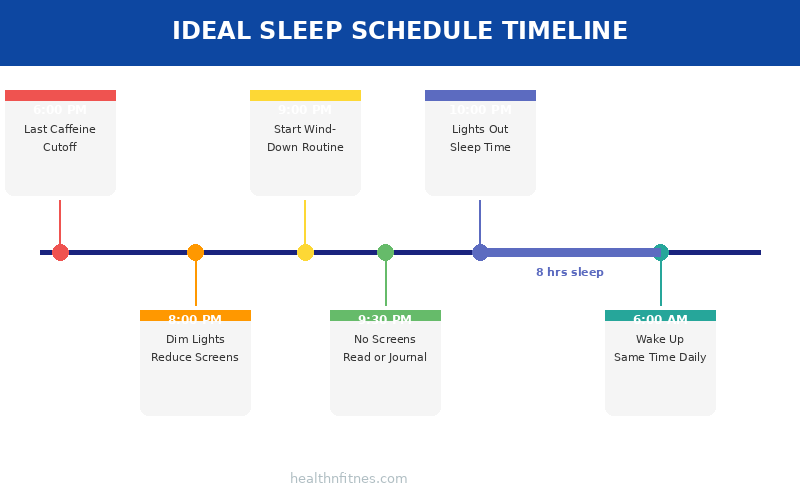
Following a structured evening timeline dramatically improves sleep onset and quality. This schedule is based on a target bedtime of 10 PM and wake time of 6 AM, providing 8 hours of sleep opportunity. Adjust the times to match your personal schedule while maintaining the intervals.
| Time | Action | Why It Matters | Duration |
|---|---|---|---|
| 2:00 PM | Last caffeine intake | Caffeine half-life is 5-6 hours | Cutoff point |
| 7:00 PM | Last meal of the day | Digestion disrupts deep sleep | 3 hours before bed |
| 8:00 PM | Dim lights, reduce screens | Triggers melatonin production | 2 hours before bed |
| 9:00 PM | Start wind-down routine | Signals brain to prepare for sleep | 1 hour before bed |
| 9:30 PM | No screens – read or journal | Eliminates blue light completely | 30 min before bed |
| 10:00 PM | Lights out – sleep | Consistent bedtime sets rhythm | Target bedtime |
| 6:00 AM | Wake up – get sunlight | Anchors circadian clock | Same time daily |
READ MORE: Yoga for Beginners at Home: The 20-Minute Routine I Wish I Started Sooner
Sleep Hygiene Checklist (12 Tips)
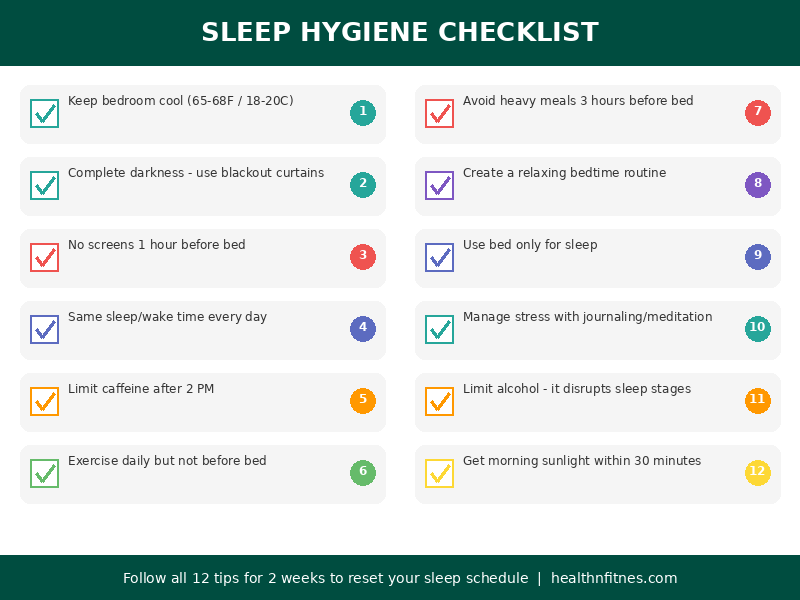
Sleep hygiene refers to the collection of habits and environmental factors that promote consistent, high-quality sleep. Implementing all twelve of the following evidence-based tips creates the optimal conditions for your body to fall asleep quickly, stay asleep through the night, and wake up feeling genuinely refreshed. Keep your bedroom temperature between 65 and 68 degrees Fahrenheit. Ensure complete darkness using blackout curtains or a sleep mask. Eliminate all screens at least one hour before bed. Go to sleep and wake up at the same time every single day, including weekends. Stop consuming caffeine after 2 PM. Exercise daily, but complete intense workouts at least three hours before bedtime.
Avoid heavy meals within three hours of sleep. Create a relaxing pre-sleep routine you follow consistently. Use your bed exclusively for sleep to maintain the brain’s association. Manage stress through journaling, meditation, or deep breathing exercises before bed. Limit alcohol consumption, as it fragments sleep architecture and reduces REM sleep even in moderate amounts. Finally, get direct morning sunlight within 30 minutes of waking to synchronize your circadian clock with the natural light-dark cycle.
How Long Does It Take to Fix Your Sleep?
The timeline for resetting your sleep schedule depends on how severely disrupted it currently is. For mild disruption, such as a one to two hour shift from staying up late on weekends, most people notice significant improvement within three to five days of consistent wake times and light exposure management. Moderate disruption from chronic irregular schedules typically requires two to three weeks of strict adherence to the strategies outlined in this guide. During this adjustment period, you may feel temporarily more tired as your body recalibrates. This is normal and should not discourage you from maintaining consistency.
Severe disruption from shift work, significant jet lag, or months of completely irregular sleep can take four to six weeks for full circadian realignment. In these cases, consider consulting a sleep specialist who may recommend chronotherapy or carefully timed low-dose melatonin supplementation to accelerate the reset process. Regardless of your starting point, the most critical factor is consistency. Missing even one or two days of your new schedule can partially reset your progress, particularly during the first two weeks. Treat your sleep schedule with the same non-negotiable commitment you would give to an important daily medication.
Frequently Asked Questions
Q1: Should I take melatonin supplements to fix my sleep schedule?
Melatonin supplements can be helpful as a short-term tool but should not be your primary strategy. Low doses of 0.3 to 0.5 milligrams taken 30 to 60 minutes before your target bedtime can help shift your circadian rhythm when combined with the behavioral strategies in this guide. However, relying on melatonin without addressing light exposure, screen habits, and sleep timing will not produce lasting results. Always consult your healthcare provider before starting any supplement.
Q2: Is it better to go to bed earlier or wake up earlier when resetting?
Always start by fixing your wake time rather than your bedtime. Your wake time and morning light exposure are far more powerful circadian signals than your bedtime. When you consistently wake at the same time and get morning sunlight, your body naturally becomes sleepy at the appropriate time in the evening. Trying to force an earlier bedtime without adjusting your wake time often leads to frustrating hours of lying awake in bed.
Q3: Why do I feel tired all day but wide awake at bedtime?
This paradox is a classic sign of a misaligned circadian rhythm, often called delayed sleep phase. Your internal clock is running later than your desired schedule, so melatonin peaks well after your intended bedtime. The solution is aggressive morning light exposure to advance your clock, strict avoidance of evening light to allow natural melatonin production, and patience as your rhythm gradually shifts earlier over one to three weeks.
Q4: Can napping help or does it make the problem worse?
Short naps of 20 minutes or less before 2 PM can provide an energy boost without significantly affecting nighttime sleep. However, longer naps or napping later in the afternoon reduce sleep pressure, the biological drive that makes you sleepy at night. If you are actively trying to fix your sleep schedule, avoid napping entirely for the first two weeks to maximize nighttime sleep pressure and help your body adjust to the new schedule faster.
Q5: Does exercise timing affect sleep quality?
Regular exercise significantly improves sleep quality, but timing matters. Morning and afternoon exercise are ideal, as they raise core body temperature, which then drops naturally in the evening, promoting sleepiness. Vigorous exercise within three hours of bedtime can be stimulating and delay sleep onset for some people due to elevated heart rate, body temperature, and adrenaline levels. Gentle activities like yoga or stretching in the evening are perfectly fine and can even enhance sleep.
Conclusion
Fixing your sleep schedule is one of the highest-impact changes you can make for your physical health, mental clarity, and emotional wellbeing. The strategies in this guide are not quick fixes or temporary hacks. They are evidence-based interventions rooted in decades of sleep science research that address the root causes of sleep disruption rather than just masking symptoms. Start tonight with three foundational actions: set a consistent wake time for tomorrow morning, put your phone away one hour before bed, and make your bedroom as dark and cool as possible. These three changes alone will produce noticeable improvements within days.
As you build momentum, gradually incorporate the full sleep hygiene checklist and evening routine timeline. Remember that sleep is not a luxury or a reward for finishing your to-do list. It is a biological necessity that determines the quality of every waking hour. Prioritize it accordingly, and explore our home workout plan, nutrition guide, and mindfulness meditation resources on healthnfitnes.com to build a complete wellness lifestyle that supports restorative sleep every night.