
What if you could transform your entire day in just 10 minutes? A quick morning workout before breakfast is one of the most powerful habits you can build for your physical and mental health. Research published in the British Journal of Sports Medicine shows that even 10 minutes of moderate exercise significantly improves mood, energy levels, and cognitive function for up to 12 hours afterward.
The best part? You do not need a gym membership, expensive equipment, or even a lot of space. This complete 10-minute morning workout uses only your body weight and can be done in your bedroom, living room, or even a hotel room. Whether you are a complete beginner or someone looking for a time-efficient routine, this guide provides everything you need: step-by-step exercise instructions, a printable routine chart, modification options, and tips to make your morning workout a lasting habit.
Why a 10-Minute Morning Workout Works
The science behind short morning workouts is compelling. A study from the University of British Columbia found that brief bouts of exercise increase blood flow to the brain by 15 percent, enhancing memory, attention, and decision-making throughout the day. Another study in the Journal of Clinical Endocrinology and Metabolism showed that exercising before breakfast burns up to 20 percent more body fat compared to exercising after eating.
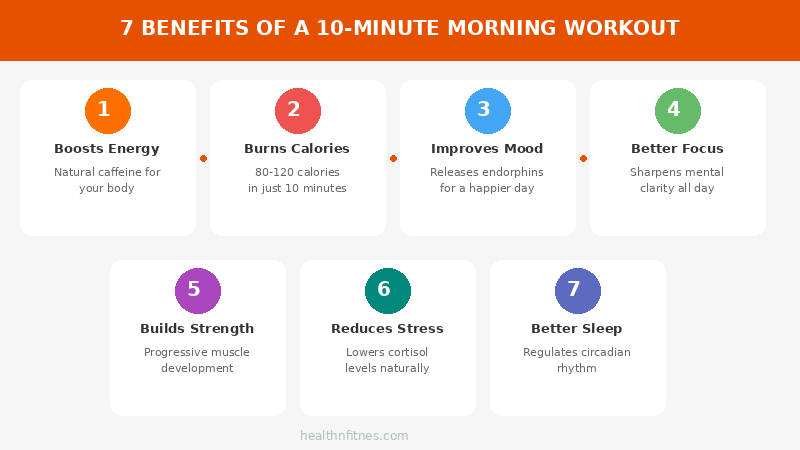
Morning exercise also elevates your resting metabolic rate for several hours through a phenomenon called excess post-exercise oxygen consumption, or EPOC. This means your body continues to burn extra calories long after your workout is finished. For a 10-minute bodyweight session, you can expect to burn 80 to 120 calories during the workout itself, with an additional 30 to 50 calories burned through EPOC over the following hours.
Perhaps most importantly, morning workouts set a psychological tone for the entire day. Completing a physical challenge first thing creates a sense of accomplishment that carries into your work, relationships, and other decisions. People who exercise in the morning are 90 percent more likely to maintain their exercise habit long-term compared to those who plan to exercise later in the day.
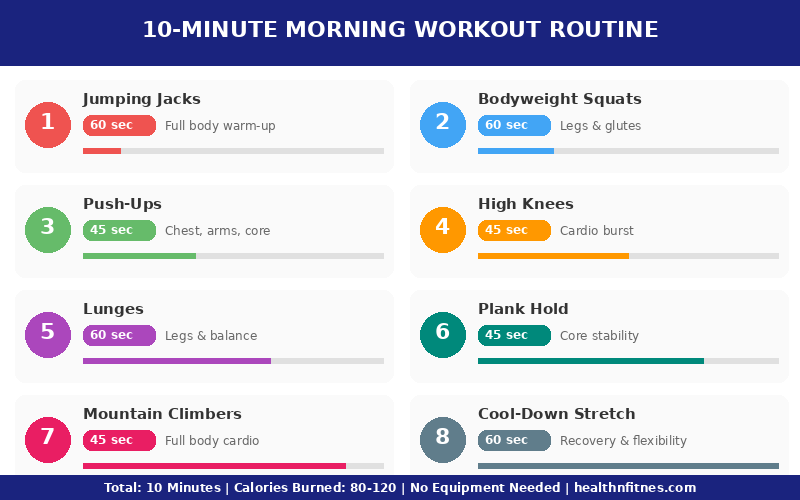
The Complete 10-Minute Routine (8 Exercises)
This routine is designed to work every major muscle group while keeping your heart rate elevated for maximum calorie burn. Each exercise flows naturally into the next, minimizing transition time. Perform each exercise for the specified duration with no rest between exercises. The only rest comes during the final cool-down stretch.
Exercise-by-Exercise Breakdown
Exercise 1: Jumping Jacks (60 seconds)
Jumping jacks are the perfect warm-up exercise because they gradually increase your heart rate while engaging your entire body. Stand with your feet together and arms at your sides. Jump your feet out to shoulder width while simultaneously raising your arms overhead. Jump back to the starting position and repeat at a steady pace. Keep your core engaged and land softly on the balls of your feet to protect your joints. Beginners can modify this by stepping one foot out at a time instead of jumping.
Exercise 2: Bodyweight Squats (60 seconds)
Stand with your feet slightly wider than shoulder width and toes pointed slightly outward. Push your hips back as if sitting into an invisible chair, keeping your chest up and your weight in your heels. Lower until your thighs are parallel to the floor, then drive through your heels to stand back up. Maintain a steady rhythm of about one squat every two to three seconds. Squats target your quadriceps, hamstrings, and glutes, which are the largest muscles in your body, making them extremely effective for calorie burning and functional strength.
Exercise 3: Push-Ups (45 seconds)
Start in a high plank position with your hands slightly wider than shoulder width. Lower your body until your chest nearly touches the floor, keeping your elbows at roughly a 45-degree angle to your body. Push back up to the starting position. If standard push-ups are too challenging, perform them with your knees on the ground or against a wall at an angle. Push-ups work your chest, shoulders, triceps, and core simultaneously, making them one of the most efficient upper body exercises available.
Exercise 4: High Knees (45 seconds)
Stand tall and rapidly drive your knees toward your chest one at a time, as if running in place. Pump your arms in opposition to your legs for balance and momentum. Keep your core tight and your back straight throughout the movement. This exercise dramatically spikes your heart rate, turning your workout into a calorie-burning powerhouse. Aim to lift each knee to hip height with every repetition. For a lower-impact modification, march in place with exaggerated knee lifts at a slower pace.
Exercise 5: Alternating Lunges (60 seconds)
Step forward with your right foot and lower your body until both knees form 90-degree angles. Your front knee should be directly over your ankle, never extending past your toes. Push through your front heel to return to standing, then repeat on the left side. Alternate legs continuously for the full 60 seconds. Lunges build single-leg strength and balance while targeting your quadriceps, hamstrings, glutes, and calves. Hold onto a wall or chair for balance support if needed.
Exercise 6: Plank Hold (45 seconds)
Lower onto your forearms and toes, forming a straight line from your head to your heels. Engage your core by pulling your belly button toward your spine. Keep your hips level, avoiding sagging or piking. Breathe steadily throughout the hold. The plank is the ultimate core exercise, simultaneously strengthening your abdominals, obliques, lower back, shoulders, and glutes. If 45 seconds is too long initially, hold for as long as you can and work up to the full duration over several weeks.
Exercise 7: Mountain Climbers (45 seconds)
Start in a high plank position. Drive your right knee toward your chest, then quickly switch legs, bringing your left knee forward as your right leg extends back. Move as quickly as you can while maintaining proper plank form. Mountain climbers combine core strengthening with intense cardio, burning more calories per minute than almost any other bodyweight exercise. Keep your hips low and your shoulders directly over your wrists throughout the movement.
Exercise 8: Cool-Down Stretch (60 seconds)
Finish your workout with gentle stretching to lower your heart rate and prevent muscle soreness. Spend 15 seconds each on a standing hamstring stretch (reach for your toes), a quad stretch (pull one foot toward your glute), a chest opener (clasp hands behind your back and lift), and deep breathing with arms overhead. This cool-down signals to your nervous system that the workout is complete and promotes faster recovery.
Workout Schedule Table
Use this printable table to track your progress. The routine stays the same, but your intensity should gradually increase as you get fitter.
| Number | Exercise | Duration | Rest | Target Muscles | Beginner Modification |
|---|---|---|---|---|---|
| 1 | Jumping Jacks | 60 sec | 0 sec | Full body | Step-out jacks |
| 2 | Bodyweight Squats | 60 sec | 0 sec | Legs, glutes | Half squats |
| 3 | Push-Ups | 45 sec | 0 sec | Chest, arms, core | Knee or wall push-ups |
| 4 | High Knees | 45 sec | 0 sec | Cardio, core | Marching in place |
| 5 | Alternating Lunges | 60 sec | 0 sec | Legs, balance | Supported lunges |
| 6 | Plank Hold | 45 sec | 0 sec | Core, shoulders | Knee plank |
| 7 | Mountain Climbers | 45 sec | 0 sec | Full body cardio | Slow mountain climbers |
| 8 | Cool-Down Stretch | 60 sec | – | Recovery | Same for all levels |
| TOTAL | 10 min | 0 sec | Full body | 80-120 calories burned |
Tips for Making It a Daily Habit
The biggest challenge with morning workouts is not the exercises themselves but building the consistency to do them every day. Set your alarm 15 minutes earlier than usual to give yourself time without rushing. Lay out your workout clothes the night before so you can start immediately upon waking. Keep a water bottle beside your bed and drink a full glass before you begin.
Read More: 30-Day Home Workout Plan for Weight Loss (No Equipment Needed)
Start with just three days per week and gradually increase to five or six days as the habit solidifies. Track your workouts on a calendar or app, because visual streaks are powerful motivators. Pair your workout with something you enjoy, such as listening to your favorite podcast or playlist during the routine. Within two to three weeks, your body will begin to crave the morning movement, and skipping it will feel more uncomfortable than doing it.
Common Mistakes to Avoid
Skipping the warm-up is the most common mistake in short workouts. Jumping jacks serve as the warm-up in this routine, so always start with them rather than jumping ahead to more intense exercises. Sacrificing form for speed is another frequent error. Every repetition should be controlled and deliberate. A slow, proper squat builds more muscle and burns more calories than ten sloppy, rushed ones.
Many people also make the mistake of holding their breath during exercises like planks and push-ups. Breathe continuously throughout every exercise, exhaling during the exertion phase and inhaling during the return phase. Finally, avoid the temptation to add extra time or exercises before your body is ready. The entire program is designed to deliver maximum results in exactly 10 minutes. Follow it as written for at least four weeks before making any modifications.
How to Progress Over Time
After four weeks of consistent practice, your body will adapt and the routine will feel easier. This is when you can begin progressions. Increase the duration of each exercise by 10 to 15 seconds, extending the total workout to 12 to 14 minutes. Add explosive variations like jump squats instead of regular squats, or decline push-ups instead of standard push-ups. Decrease rest between exercises by moving faster through transitions.
Read More: Abdominal Home Workout: Strengthen Your Core with These 5 Exercises
You can also add resistance by holding water bottles during lunges and squats, or wearing a loaded backpack during push-ups and planks. Once you can complete the full routine without needing modifications, consider adding a second round for a 20-minute session, or explore our full body home workout for beginners and 15-minute HIIT workout guides on healthnfitnes.com for more challenging routines.
Frequently Asked Questions
Q1: Is 10 minutes of exercise in the morning really enough?
Yes. Multiple studies confirm that 10 minutes of moderate to vigorous exercise provides measurable health benefits, including improved cardiovascular fitness, reduced anxiety, better blood sugar regulation, and enhanced cognitive performance. While longer workouts offer additional benefits, 10 minutes is far superior to zero minutes. For beginners, a consistent 10-minute daily habit builds the foundation for longer, more intense sessions as fitness improves.
Q2: Should I eat before or after my morning workout?
For a 10-minute session, exercising on an empty stomach is perfectly safe and may actually enhance fat burning. A study in the Journal of Clinical Endocrinology and Metabolism found that pre-breakfast exercise burns 20 percent more fat. However, if you feel dizzy or lightheaded, have a small snack like half a banana 15 minutes before your workout. Always eat a balanced breakfast containing protein and complex carbohydrates within 30 to 60 minutes after finishing your routine.
Q3: Can beginners do this workout?
Absolutely. Every exercise in this routine includes a beginner modification. Wall push-ups, marching instead of high knees, half squats, and knee planks allow complete beginners to complete the full 10 minutes safely. Start with the modifications and gradually transition to the standard versions as your strength and endurance improve. Most beginners can perform the full unmodified routine within two to four weeks of consistent practice.
Q4: How many calories does this workout burn?
A 10-minute bodyweight circuit burns approximately 80 to 120 calories depending on your body weight, intensity, and fitness level. A 150-pound person performing the exercises at moderate intensity burns about 90 calories, while a 200-pound person at high intensity may burn 120 or more. Additionally, the afterburn effect (EPOC) adds another 30 to 50 calories of elevated calorie burn over the following two to four hours.
Q5: Can I do this workout every day?
Yes, this routine is designed for daily use. Because it lasts only 10 minutes and uses bodyweight exercises at moderate intensity, your muscles have adequate time to recover between sessions. However, if you experience muscle soreness, especially during the first week, take one or two rest days and resume when the soreness subsides. As your body adapts, daily performance becomes comfortable and sustainable for long-term health benefits.
Conclusion
A 10-minute morning workout is the single smallest investment that produces the largest return on your physical and mental health. In the time it takes to scroll through social media or wait for coffee to brew, you can boost your energy, burn calories, strengthen your muscles, and set a positive tone for everything else in your day.
This routine requires no equipment, no gym, no experience, and no excuses. Start tomorrow morning with the beginner modifications if needed, and commit to just one week. By day three, you will notice improved energy. By day seven, you will not want to stop. By day thirty, it will be as automatic as brushing your teeth. For more home workout routines, including our full body workout for beginners, 15-minute HIIT workout, and core strengthening guide, visit healthnfitnes.com. Share this workout with someone who wants to start their fitness journey but thinks they do not have enough time.